

By the Humyn Labs team. Updated June 2026.
| TL;DR AI projects collapse at the data stage far more often than the model stage. This guide to data labeling breaks down what labeling is, the core types and methods, the quality slips that quietly drain accuracy, and how to choose between in-house, outsourced, and hybrid teams. Sharp labels build models that ship. Sloppy ones torch your budget. Humyn Labs hands you verified human annotators, auditable workflows, and on-chain proof of skill, so your training data survives real scrutiny. Want labeled data you can defend? Talk to Humyn Labs. |
| Quick answer: What is data labeling? Data labeling means tagging raw data, including images, text, audio, and video, with context that lets machine learning models learn from it. The process converts messy, unstructured input into clean examples a model trains on. Strong labeling moves model accuracy more than almost anything else you can touch. |
Your AI keeps making dumb mistakes. The labels are usually why.
The model was fine. The data labeling was a wreck. That sentence explains most failed AI projects I have ever seen, and the story barely changes from one team to the next.
Picture it. A team picks a strong model. They buy the compute. They wait. The thing ships, then face-plants. It reads a stop sign as a billboard. It scores an angry email as upbeat. Everyone points at the algorithm. Almost nobody opens the dataset.
But the labels were the problem all along. Wrong tags, ragged edges, ten annotators who each read the rules their own way. Garbage in, garbage out, except this garbage showed up wearing a lab coat.
So let me keep it blunt. If you want AI that holds up in the real world, you fix the labels first. This guide to data labeling takes you through the whole job, from what labeling actually means to how you build a pipeline that performs in production. No filler. Just what moves accuracy.
And the clock matters here. The AI data labeling market sits near USD 2.3 billion in 2025 and should hit roughly USD 18 billion by 2035 at about 23 percent CAGR. One stubborn truth drives that curve: models crave high-quality labeled data, and they crave a lot of it.
Source: Precedence Research, 2026.
What is data labeling, really?
Cut the buzz and it gets simple. You take raw data and attach tags that tell a model what sits in front of it. A photo gets a box drawn around the cat. A sentence gets flagged as a complaint. A clip of speech gets matched to its text. That is data annotation, and no model learns a supervised task without it.
Picture teaching a toddler with flashcards. You hold up an apple, say apple, repeat it across a few hundred different apples. One day the kid spots a new apple and nails it. Your model learns the same way, only it needs thousands of clean flashcards and carries zero common sense to rescue a bad one.
That is why labeled data anchors every AI product you touch. The model plays student. The training data plays the lesson. Teach it cleanly and it generalizes. Teach it sloppily and it memorizes your errors.
Humyn Labs pushes past the usual setup. Every annotator carries a verified profile, so you know who labeled your data and where their strengths sit. See how that works on the expert profiles page.
Why labeling decides whether your AI thrives or flatlines
Here is the bit leadership keeps skipping. More than 70 percent of model performance gains now trace back to data quality, not to clever architecture. Swap models all week. Weak labels keep the ceiling low anyway.
Source: Technavio, 2026.
Bad labels do more than dent a dashboard number. They drain real cash. You pay to label once, pay again when the model underdelivers, then pay a third time while your team rebuilds the dataset and retrains. Three invoices for one task.
Then bias creeps in. When your annotated data tilts one way, the model swallows that tilt and serves it to every user at scale. In regulated fields like healthcare and finance, that stops being awkward and starts being a compliance failure with consequences.
Regulators caught on. The EU AI Act now requires traceable, well-documented training data for high-risk systems. So clean labeling graduated from nice-to-have to legal armor. That is precisely where auditable workflows pay off, and a big reason teams switch to Humyn Labs.
Quick gut check: could you prove who labeled your last dataset and why each call was made? If that question makes you wince, keep reading.
Types of data labeling, sorted by data format
Your use case picks your labeling type. Match them well and the pipeline flows. Match them badly and you fund work that never helps the model.
Image and video labeling
Bounding boxes, segmentation masks, keypoints, and 3D cuboids. This feeds computer vision, from retail shelf scans to self-driving perception. Image and video form the fastest-growing market slice, close to 41 percent of revenue in 2025, because autonomous systems devour visual labels nonstop.
Text labeling
Named entity recognition, sentiment, intent, and classification. This carries search, chatbots, and every large language model that has to separate a refund request from a meltdown.
Audio and speech labeling
Transcription, speaker tags, and event detection. If you build voice assistants or call analytics, this is your core. Humyn Labs runs dedicated audio transcription services and voice data collection for this exact need.
Sensor and physical-world data
LiDAR point clouds, sensor fusion, and egocentric video for robotics. As embodied AI expands, this turns into the frontier. See how Humyn Labs handles it on the physical AI data page.
Data labeling methods and their honest tradeoffs
No method wins on every front. There is only the right one for your accuracy, speed, and budget. So which fits your project? Start here.
| Method | Best for | The catch |
| Manual human labeling | High-stakes accuracy, edge cases, medical and legal | Slower, higher cost per label |
| Automated and programmatic | Huge volume, repetitive patterns | Misses nuance, needs review |
| Semi-supervised and human-in-the-loop | Scale without dropping quality | Needs solid tooling and oversight |
| Synthetic data | Rare events, privacy-sensitive cases | Can drift from real-world distribution |
The smart play is rarely one method. It is a mix. Machines pre-label the easy 80 percent. Verified humans take the brutal 20 percent and catch what the machine botches. Scale AI trimmed labeling time by up to 80 percent with this split. Humyn Labs runs the same human-in-the-loop logic, but with annotators whose skill is proven instead of assumed. See the human-in-the-loop approach.
How to fix the labeling problems that quietly drain accuracy
Most labeling pain springs from a short list of culprits. Here is how you beat each one.
- Inconsistent labels across annotators. Ten people, ten readings. The fix is a clear guideline document with real examples and edge cases written out. Fuzzy instructions breed fuzzy data.
- Scaling volume without losing quality. More hands alone backfires. You need task routing that sends work to people who are genuinely good at it, plus layered review.
- Ambiguous and edge cases. The strange 5 percent wrecks models in production. Flag them, route them to senior annotators, and record the call so the next person stays consistent.
- Hidden bias. Diverse annotators and diverse data shrink skew before it reaches your model. A uniform crowd bakes in a uniform worldview.
- No quality check. Without multi-layer validation, errors slide straight into training. You want consensus scoring, spot audits, and a feedback loop that actually learns.
Here is the Humyn Labs answer in one line: verified humans, skill-based routing, multi-layer validation, and full traceability. Bad labels get caught long before they reach your model. The data quality assurance solution is built around this exact problem.
In-house vs outsourced vs hybrid: which one fits you?
No single answer wins. There is only the right fit for your data, your risk, and your scale.
Keep it in-house when
- Your data runs highly sensitive or proprietary, and control matters more than speed.
- You need deep domain context that only your own team carries.
Outsource when
- You need to scale fast without recruiting and training a labeling army.
- You want specialized tooling and quality certifications you lack internally.
Go hybrid when
You want both. Hold sensitive work in-house, push high-volume work to a trusted partner. Hybrid sourcing now grows fastest in the market, above 22 percent CAGR, because it balances control and scale. Most serious teams settle here.
Source: Mordor Intelligence, 2026.
Outsourced labeling still leads overall, yet rising IP worries and a shortage of domain experts keep nudging budgets toward mixed models. Humyn Labs slots into that hybrid reality cleanly. You get on-demand verified experts plus auditable workflows, so you scale without losing the thread on quality or provenance.
A data labeling workflow you can copy today
This workflow works. Treat it as a checklist.
- Define your goal and success metric. Decide what a correct label looks like and how you will measure agreement.
- Write the guideline document. Lay out classes, edge cases, and examples. This one doc decides your data quality.
- Pick your tools or partner. Match the platform to your data type and compliance needs.
- Run a small pilot. Label a sample batch, measure inter-annotator agreement, then tighten the guidelines.
- Scale with review. Roll out volume with layered QA built in, not bolted on later.
- Audit and improve. Keep the feedback loop running. Labeling is a process, not a one-off.
Humyn Labs runs this exact flow from request to delivery, with quality baked into every stage. See the full process on the how it works page.
What you actually get when labeling is done right
For your business
Faster time to market, higher model accuracy, and lower long-term cost, because the rework tax disappears. Picture a warehouse vision model trained on precise video labels that tracks inventory at over 98 percent accuracy, a job that falls apart on sloppy data. Clean training data also builds a moat. It resists copying and it compounds.
For your ML team
Less cleanup, cleaner pipelines, and models that generalize instead of memorizing noise. Your engineers spend their hours on modeling, not on babysitting broken labels.
For you, personally
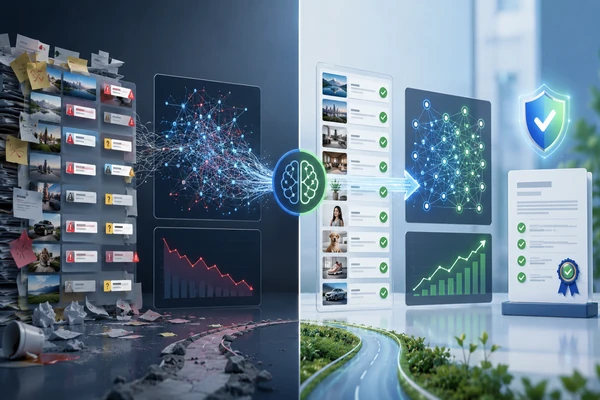
Fewer fire drills. Fewer production surprises. And a dataset you can hand an auditor without breaking a sweat. That last one weighs heavier every quarter.
Where data labeling heads next
AI-assisted labeling is climbing fast, and that helps. Machines now handle the repetitive bulk, which frees humans for the judgment calls. But one thing holds firm: the human stays the quality gatekeeper. Models can pre-label. They still cannot feel the weight of a wrong call on a medical scan.
That sits at the heart of the Humyn Labs thesis. Before data becomes truth, it moves through human hands. As models grow hungrier and rules grow stricter, verified human judgment becomes the line between data you can trust and data you merely hold. Read more on the Humyn Labs blog.
Common mistakes to avoid
- Treating labeling as a one-time task. It runs as an ongoing process with a feedback loop.
- Skipping the pilot. You learn your guideline gaps cheaply in a small batch, painfully at full scale.
- Chasing volume over accuracy. A million bad labels lose to ten thousand good ones.
- Ignoring provenance. If you cannot trace who labeled what, you cannot defend your data to a regulator.
- Leaning on anonymous crowds with no skill check. Unknown hands deliver unknown quality.
The bottom line
AI that performs in the real world does not begin with a bigger model. It begins with disciplined data labeling. Get the labels right and everything downstream gets lighter. Get them wrong and no architecture bails you out.
So audit your pipeline. Write the guideline doc. Run the pilot. And when you want labeled data you can stand behind, data built by verified humans with auditable workflows and proof of expertise, that is the Humyn Labs job.
| Ready to build training data you can defend? Humyn Labs delivers verified human annotators, multi-layer quality checks, and full traceability across every modality. Schedule a call with Humyn Labs and watch how it performs on your data. |
Frequently asked questions
What is data labeling in machine learning?
Data labeling tags raw data such as images, text, audio, and video with context so a machine learning model can learn from it. The process turns unstructured input into structured examples for supervised training.
Why is data labeling so important for AI?
Because model accuracy rides on it. More than 70 percent of performance gains trace back to data quality rather than architecture. Poor labels cap your model no matter how strong the algorithm.
What are the main types of data labeling?
The main types follow data format: image and video labeling, text labeling, audio and speech labeling, and sensor or physical-world data labeling. Your use case picks the right one.
Should I label data in-house or outsource it?
It hinges on sensitivity, scale, and expertise. Keep it in-house for highly sensitive data, outsource to scale fast, or go hybrid to balance both. Hybrid grows fastest right now.
How do I ensure data labeling quality?
Write a clear guideline document, run a pilot to measure annotator agreement, use skill-based routing, and add multi-layer validation. Humyn Labs builds these checks into every workflow.
How much does data labeling cost?
It shifts with data type, complexity, and method. Specialized work like medical or legal annotation costs more than simple classification. A hybrid approach often cuts total cost by automating the easy work and saving experts for the hard cases.
