
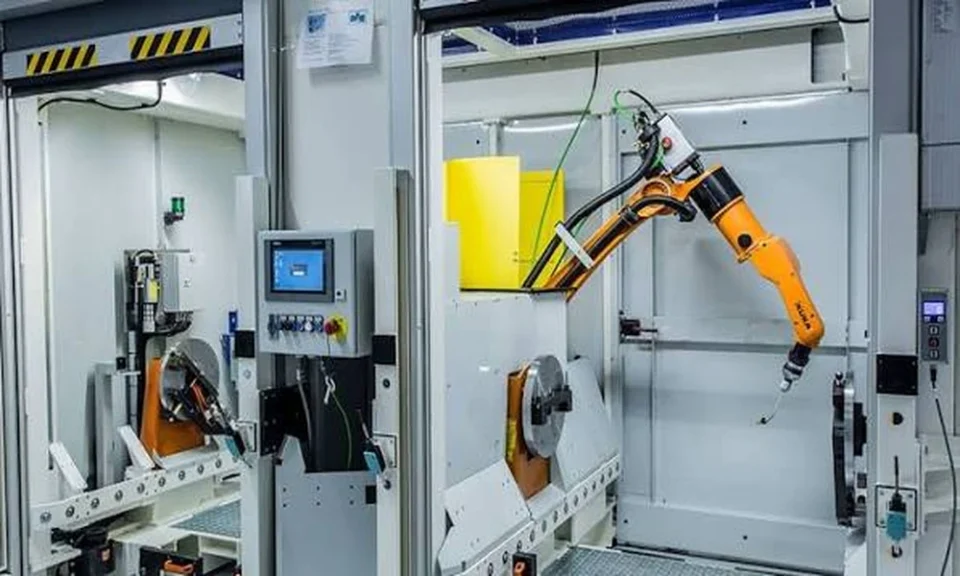
An industrial robot arm is fundamentally a positioning system. The task itself is completed at the wrist, where a tool must grip, press, fasten, polish, detect contact or release a product without damage. Improvements in end-of-arm tooling therefore expand what a robot can do in practice without requiring a completely different arm for every operation.
The tool defines the real application
Payload, reach, speed and repeatability establish the operating envelope of the robot, but they do not tell the whole story. A vacuum cup that cannot seal on a porous carton will fail regardless of arm precision, and a finishing process without controlled contact can produce inconsistent results even on a repeatable path. Tool selection should begin with geometry, mass, centre of gravity, surface condition, allowable marking, process forces and the environment around the task.
Programmable gripping handles useful variation
Electric grippers can add adjustable stroke, force and position feedback to applications where fixed tooling would require more mechanical changeover. Within the Onrobot ecosystem, that kind of programmable end-of-arm tooling can be combined with other devices and application logic so a recipe can change gripping behaviour while the cell still receives useful state information. Feedback can then reveal an empty pickup, a misoriented component or two parts stuck together, moving fault detection closer to the point where the problem occurs.
Force feedback changes how robots interact with surfaces
Many manual operations depend on feel rather than exact position. Insertion, deburring, sanding and polishing may require the tool to react to resistance or slight geometric differences. Force-aware devices can bring tool state and contact information into the application logic, but the engineer still has to define acceptable force windows and failure responses. Sensing makes the process observable; it does not make the process automatically correct.
Tool changing makes the arm reusable
A cell becomes more valuable when one robot can support more than one product or task over its working life. Quick changers reduce the mechanical effort of swapping end effectors, while dual-tool arrangements can shorten some machine-tending sequences by carrying incoming and finished parts at the same time. Every configuration still changes wrist mass, offset and accessible workspace, so approved tool combinations need validation instead of assuming that a common flange makes them interchangeable.
Software is what turns devices into one process
Smart hardware adds little value if every setting requires custom code. Useful tooling exposes clear parameters, state information and fault messages through the robot environment or a common application interface. Product recipes can then change grip width, contact force or tool speed while safety functions and cell-level logic remain controlled separately. This separation makes routine changeovers easier without allowing a simple product edit to alter protective behaviour.
Better tooling does not remove integration work
Cables still need correct routing, fingers wear, suction is affected by dust and fixtures must present parts inside an achievable range. Safety assessment must also include the tool and carried object, not just the robot arm. The most important shift is therefore not one new gripper specification, but the combination of adaptable mechanics, useful sensing and reusable software. When those elements are engineered together, the same arm becomes a more durable production asset across several well-defined tasks.
Tooling should be specified as part of lifecycle design
End effectors are consumable mechanical systems as well as sources of capability. Fingers wear, pads age, seals leak and connectors are repeatedly cycled during changeovers, so spare parts and inspection intervals should be considered at the design stage. A tool that is easy to configure but difficult to maintain can still become the weak point of the cell. Lifecycle planning keeps the wrist from becoming an overlooked source of downtime.
